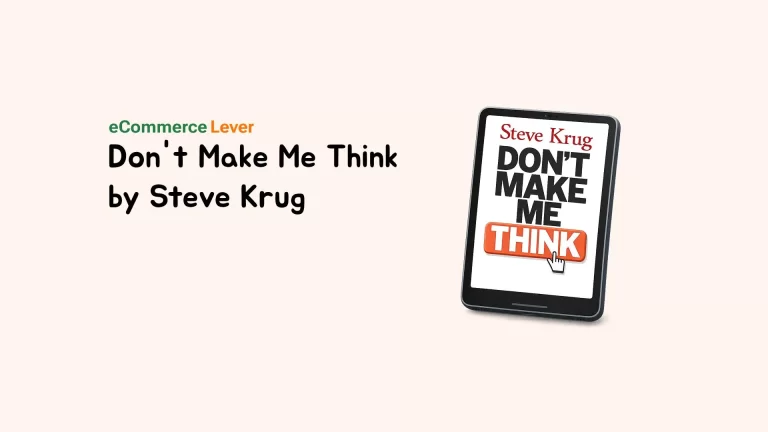
Don’t Make Me Think by Steve Krug is my favorite book on usability and probably the most well-known one in the field. First published in 2000, it remains just as relevant and applicable today. I highly recommend it to anyone involved in building websites or trying to make them profitable.
The book is written in a clear, simple style and is very easy to read. It’s only about 200 pages long, but it’s full of illustrations, uses large fonts, and feels much shorter than a typical book. You can easily finish it in a single day. It avoids technical jargon, so even people with no background in web development can understand it.
Fortunately, common sense is at the core of what I do, and anyone can learn to apply it.
Steve Krug
Many of the ideas in the book feel so obvious that it’s hard to believe we didn’t always know them — maybe only back in childhood. But that’s exactly what makes them valuable: simple “this is how it should be” and “this works better” principles are turned into clear, logical guidelines.
Don’t Make Me Think can also be seen as a practical guide for anyone involved in building and optimizing websites — product managers, marketers, UX specialists, and eCommerce teams. It’s a great source of arguments in favor of creating experiences that actually work for users and drive business results, rather than just following subjective preferences or copying competitors.
Of course, simply referencing the book won’t convince anyone on its own. You still need to think critically and look at the site through the eyes of real users. Not everyone can be Steve Krug, but we can learn from his extensive experience. The book even includes a full chapter on aligning stakeholders, with practical examples for navigating common disagreements and decisions.
The actual Average User is kept in a hermetically sealed vault at the International Bureau of Standards in Geneva.
Steve Krug
The common misconception that we can design for an “average user” is brilliantly debunked. It’s similar to the idea of the “average hospital temperature” — something you can calculate, but that has no real meaning.
The myth of the average user makes us believe that whatever most people like must be the right solution. For example, dropdown menus are either “good” (because most people like them) or “bad (because most people don’t). In reality, any design decision only makes sense in the context of a specific task on a specific page of a specific website, which is exactly why usability testing is so important.
The truth is, there are no simple “right” answers to most web design questions (at least not the important ones). What works is what meets users’ needs — if it’s well thought out, well executed, and properly tested.
The absence of one-size-fits-all answers makes decisions harder to defend, but that’s exactly what makes this work interesting. If there were only one correct solution to every problem, all websites would look the same. Using Flash as an example, Krug shows that even its biggest critics wouldn’t object to small, well-designed elements that enhance functionality and bring a site to life.
The only reliable way to find the “right” answer is through testing. Usability testing shows us just how differently people perceive a website and interact with its elements. Ultimately, it helps us arrive at better decisions.
The book includes a large section on usability testing, covering both professional testing conducted by experts and simple, low-cost testing you can do yourself. Krug explains how to run these tests with practical examples.
Why didn’t we do this sooner?
That’s something everyone says the first time they observe usability testing of their own site.
I found that especially relatable. It’s a question I’ve asked myself many times — usually only after gaining experience. Just imagine how much time and effort could have been saved by focusing on the right things from the start.
Some other memorable quotes from the book
We’re thinking “great literature” (or at least “product brochure”), while the user’s reality is much closer to “billboard going by at 60 miles an hour.”
Usability is about people and how they understand and use things, not about technology.
Don’t make me think!
The First Law of Usability
It doesn’t matter how many times I have to click, as long as each click is a mindless, unambiguous choice.
Krug’s Second Law
Get rid of half the words on each page, then get rid of half of what’s left.
Krug’s Third Law